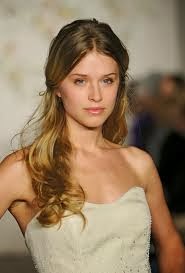
 Hair and make-up is going to be an important factor within our music video. We wanted to link to John Newman's retro style, so have decided to opt for a vintage look rather than a modern take. Therefore, we have decided that the, 'half up-half down' style will work really well for the female actors; it will ensure that we can see their faces, yet it will add to the concept of movement within our piece too, which perhaps a more controlled hair do would not allow. We wanted again, to relate to the dance/party vibe within our music, therefore, the actors will wear bold eye-liner and red lipstick to represent getting dressed up for a night out or a party. We thought that foundation/colour of skin wouldn't be of quite as much importance, as soon they would be covered in paint!
Sunday, 13 October 2013
Powder Paint Fight: Hair & Make up Research
Hair and make-up is going to be an important factor within our music video. We wanted to link to John Newman's retro style, so have decided to opt for a vintage look rather than a modern take. Therefore, we have decided that the, 'half up-half down' style will work really well for the female actors; it will ensure that we can see their faces, yet it will add to the concept of movement within our piece too, which perhaps a more controlled hair do would not allow. We wanted again, to relate to the dance/party vibe within our music, therefore, the actors will wear bold eye-liner and red lipstick to represent getting dressed up for a night out or a party. We thought that foundation/colour of skin wouldn't be of quite as much importance, as soon they would be covered in paint!

Saturday, 12 October 2013
Powder Paint Fight: Costume Research
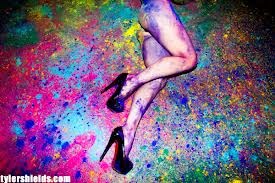
Initially, we thought that a 60's style fashion would look great as it would highlight the movement through all of the statement dresses. However, we then realised that this would not work so well with the modern, stylistic setup we are creating for the second scene.
We then became inspired by Tyler Shields' photography work, 'Chromatic'. His models wore white and black outfits which made the colours stand out very well.
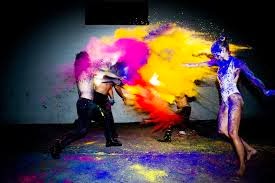 From here, we made the decision that the girls will wear white, sleeveless skater dresses and black high heels, whilst the boys will wear dark trousers and a smart white shirt. We chose these outfits as they are a mixture of smart and casual, so can be dressed up/down as appropriate. Therefore, this holds connotations with partying.clubbing, which is where our song would be most likely to be heard; we are making small links for the audience to match the visuals to the music.
Thursday, 10 October 2013
Powder Paint Fight: Prop Research
 The most prominent prop we will be using is the powder paint. This is a chalk-like substance which creates some great effects when used in a variety of ways.
 We had to be aware of the quantity we would need, as we want to avoid re-shooting down to a lack of supplies, and we also wanted to get as much footage as possible.
Another consideration was the cost side of things. We didn't have a huge budget so wanted to get the best value product.
 Lastly, we thought about which colours we wanted to use. We decided to go for bright, vibrant colours as these would provide a greater contrast against the darker setting. We have chosen pink. blue, green, orange, red and yellow and have ordered 2.5kg of each which we think will be enough to last us for this shoot, and hopefully some left over too.
Monday, 7 October 2013
Ideas Update
We have intensely brainstormed about the features of our music videos. Our initial idea was to have the setting/concept as summer,parties, festivals etc as this would really suit teh vibe of the song. However, we thought that this was a little bit predictable and 'safe' and we wanted to push the boundaries a bit. Also, we would have been doing the majority of our filming over winter, so this idea was also impractical.
We further filtered through various ideas, and after studying several existing dance music videos, realised that there is commonly a narrative which goes alongside the concept. The concept within our song is love, fighting and forgiveness, so we came up with the idea of having a 2 person narrative between a boy and a girl which works alongside our concept.
Now we had this idea of narrative in mind, we had to develop a concept. Again after lots of research, we realised that colour was an essential theme within dance video, as it exagarates the bold, confident music. Therefore, we have come up with the idea of a powder paint fight. We will film this at night to contrast lights, darks and colours against each other.
To summerise, we will have 2 scenes; the first with a couple arguing in a non-naturalistic house setup (i.e. quite simplistic and representative rather than realistic) and the second, a poder paint fight between 3 couples.
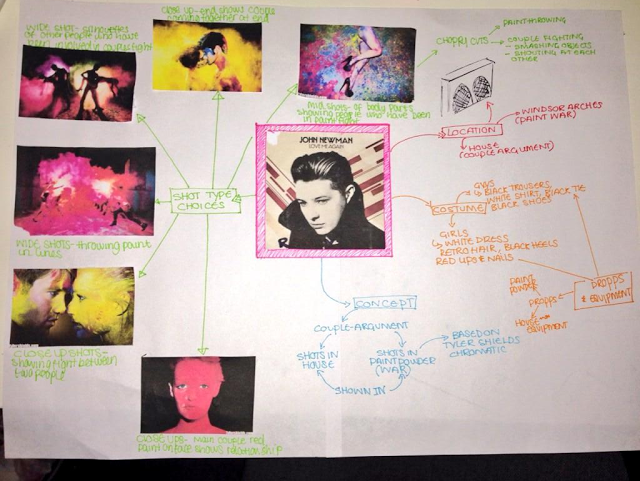
We further filtered through various ideas, and after studying several existing dance music videos, realised that there is commonly a narrative which goes alongside the concept. The concept within our song is love, fighting and forgiveness, so we came up with the idea of having a 2 person narrative between a boy and a girl which works alongside our concept.
Now we had this idea of narrative in mind, we had to develop a concept. Again after lots of research, we realised that colour was an essential theme within dance video, as it exagarates the bold, confident music. Therefore, we have come up with the idea of a powder paint fight. We will film this at night to contrast lights, darks and colours against each other.
To summerise, we will have 2 scenes; the first with a couple arguing in a non-naturalistic house setup (i.e. quite simplistic and representative rather than realistic) and the second, a poder paint fight between 3 couples.
Friday, 4 October 2013

Thursday, 3 October 2013
Artist Research: John Newman Representation & Style
Newman's style is rather retro and vintage; high contrasts of black and white with splashes of bold colours. His facial expression in bith his album and single CD covers is quite reflective, which links to the style of his songs, as they often follow themes of love, regret and forgiveness; not giving up. He explains that his album is a break up album. Most of his influences come from blues/jazz music after he worked in a bar, which he expands on below:
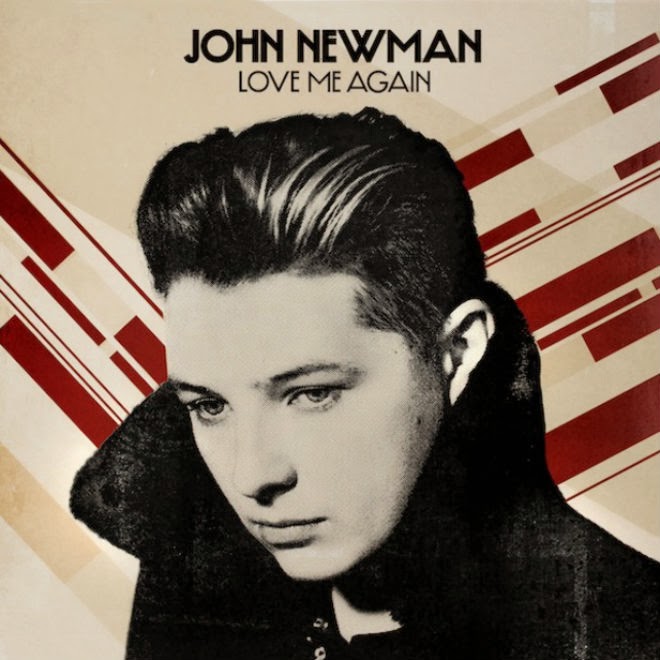 In the cover of his Love Me Again single and the Tribute album, his retro influences are clear to see. From this, we can tell that his music will be more than a pop/indie album; it is a throwback and vintage with a modern twist. The colour contrasts add energy to what would have been a purely blackand white album, which again relates to the style of his music
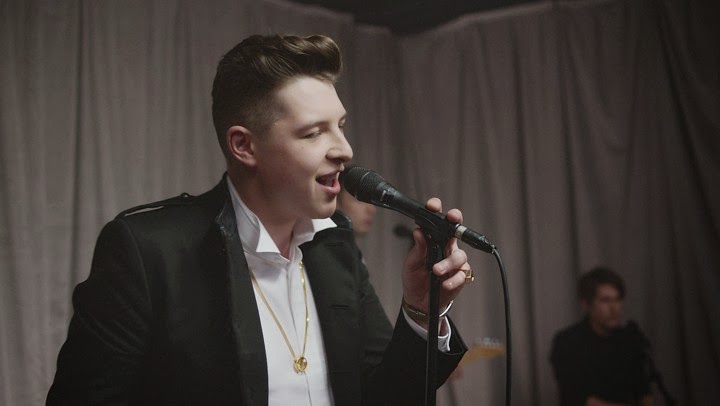 In terms of his fashion style, his love of vintage and retro comes through in this sense too. In love me again music video, the dancers all were very 60's style clothing, so floral dresses with slim waists and bold skirts and casual suits. Newman's hair also reminds me of the 60's aura, due to the statement quiff and slight colour streak. So in conclusion, his retro roots have had a huge influence on the style of his music as well as his look.
 In the cover of his Love Me Again single and the Tribute album, his retro influences are clear to see. From this, we can tell that his music will be more than a pop/indie album; it is a throwback and vintage with a modern twist. The colour contrasts add energy to what would have been a purely blackand white album, which again relates to the style of his musicIn terms of his fashion style, his love of vintage and retro comes through in this sense too. In love me again music video, the dancers all were very 60's style clothing, so floral dresses with slim waists and bold skirts and casual suits. Newman's hair also reminds me of the 60's aura, due to the statement quiff and slight colour streak. So in conclusion, his retro roots have had a huge influence on the style of his music as well as his look.
Artist Research: John Newman Early Life & Career
John Newman grew up in Settle in the Yorkshire Dales. At the age of fourteen, he started to play the guitar which led him to begin writing his own songs. Naturally, he soon learnt how to record and produce musical content himself. He used this skill to create his own house tracks and did some freelance DJ'ing to gain even more experience.
When he was 20, Newman moved to London and started his own band who took part in many live gigs at a range of venues. Following this, he was spotted and signed by Island Records and produced, 'Love Me Again' as his debut single.
In May 2012, he featured in the established pop/dance group, Rudimental's single, 'Feel The Love' which reached number one in the UK charts. He then featured as the vocals in their second collaboration for the song, 'Not Giving In' during November 2012.
Now he was beginning to be recognised as an artist, he released his own single, 'Love Me Again' which peaked at number 1 in the UK charts in July 2013. Following the successof this, he released, 'Cheating' in October from his debut studio album, Tribute. He has immensely grown as an artist and become increasingly popular within the music industry in a short space of time which demonstrates the potential he has as an artist.
When he was 20, Newman moved to London and started his own band who took part in many live gigs at a range of venues. Following this, he was spotted and signed by Island Records and produced, 'Love Me Again' as his debut single.
In May 2012, he featured in the established pop/dance group, Rudimental's single, 'Feel The Love' which reached number one in the UK charts. He then featured as the vocals in their second collaboration for the song, 'Not Giving In' during November 2012.
Now he was beginning to be recognised as an artist, he released his own single, 'Love Me Again' which peaked at number 1 in the UK charts in July 2013. Following the successof this, he released, 'Cheating' in October from his debut studio album, Tribute. He has immensely grown as an artist and become increasingly popular within the music industry in a short space of time which demonstrates the potential he has as an artist.
Tuesday, 1 October 2013
Song Choice
We wanted to avoid any copyrighting issues, so contacted the owner of the song to ask if we could have rights to use the song.
We did have a back-up plan of using a different one, just in case there were any issues with this one but luckily the company emailed us back confirming that we could use the soundtrack no problem.

This means we can power ahead with our planning and preparation for the shoot, which we are all really excited about.
We did have a back-up plan of using a different one, just in case there were any issues with this one but luckily the company emailed us back confirming that we could use the soundtrack no problem.
This means we can power ahead with our planning and preparation for the shoot, which we are all really excited about.
Saturday, 28 September 2013
Island Records
Island Records are a huge institution who manage a number of very successful music artists. The label was founded by Chris Blackwell and Graeme Goodall in Jamaica in 1959. It then came to be based in the UK and is owned by the Universal Music Group, however they are based in many other countries, including America and Australia.
John Newman was signed at teh age of 20, amongst other artists including:
John Newman was signed at teh age of 20, amongst other artists including:
- Jessie J
- Dizzee Rascal
- Disclosure
- Bombay Bicycle Club
- Drake
- Avicii
- Ben Howard
- Dappy
- Mumford and Sons
- Nicki Minaj
- The Wanted

It is clear to see that they support a wide range of genres, from Ben Howard's indie style to Dappy's hip hop/rap clique. They have grown to be one of the leading record companies across the globe and are well recognised by both musical talents and the public alike.
Director Case Study: Shane Drake
Shane Drake is an American Director who's experience involves directing over 50 music videos as well as co-producing three films. Early in his career, Drake spent time working as an editor and cinematographer with such bands as Poison the Well, Deftones, Thursday and many more. He now spends most of his time directing and is the owner of red Van Pictures, a Los Angeles-based production company.
Drake has directed videos spanning the genres of Pop, Rock, Rap and Country, He has worked on music videos for artists including Timbaland, Paramore, Kelly Clarkson, Avril Lavigne, Fall Out Boy, Flo Rida, Will I Am, Tim McGraw, Taylor Swift, Keith Urban, Daughtry and many more.
As well as working with multi-platinum artists, Shane has also helped shape some of the original visual styles for new bands that have also gone on to see great success, the most notable of these acts being Panic! At The Disco. Since the band’s inception, Shane’s work with them has earned several VMA nominations and won “Video Of the Year” at the 2006 MTV VMA’s for the video “I Write Sins Not Tragedies”.
His style wavers more towards indie/rock/pop combinations which are genres where his most iconic music videos can be found. Here are some more examples:
Drake has directed videos spanning the genres of Pop, Rock, Rap and Country, He has worked on music videos for artists including Timbaland, Paramore, Kelly Clarkson, Avril Lavigne, Fall Out Boy, Flo Rida, Will I Am, Tim McGraw, Taylor Swift, Keith Urban, Daughtry and many more.
As well as working with multi-platinum artists, Shane has also helped shape some of the original visual styles for new bands that have also gone on to see great success, the most notable of these acts being Panic! At The Disco. Since the band’s inception, Shane’s work with them has earned several VMA nominations and won “Video Of the Year” at the 2006 MTV VMA’s for the video “I Write Sins Not Tragedies”.
His style wavers more towards indie/rock/pop combinations which are genres where his most iconic music videos can be found. Here are some more examples:
Friday, 27 September 2013
Synethesia
Today we learnt about the concept of synaesthesia, which by definition means, "the process of picturing sounds in the mind's eye". It is often seen as the joining of senses, for sensations in one modality (e.g hearing) produce reactions in the form of a sensation in another modality (e.g. colour) as well as it's own. These experiences are not often driven by sensory representations, but more so by symbolic ones, such as letters, numbers and words. It can also be known as, 'thought beats' or, 'seeing sounds in your head'
Andrew Goodwin is a contemporary theorist and on the subject of synesthesia in relation to music videos, he believes the most succesful sort is:
"A clip that responds to the pleasures of music, and in which that music is made visual, either in new ways or in ways that accentuate existing visual assosiations"
~ Andrew Goodwin (1993)
I like his ideas; he is basically saying that when the visuals of media content complement the features of the sound, it all seems to come together and exaggerate what the visuals already in place. Also, when you are able to take in and understand the information your senses relay to you, you tend to have more interest in the content you are viewing, which in turn make the content more popular.
Steve Archer also provided many of his own ideas and opinions on the matter in the February 2004 edition of MediaMagazine. He believed that in order to judge appropriately, you need to fully be aware of the music and how it makes you feel.
HOW WE USED SYNAESTHSIA TO OUR ADVANTAGE
We did a task whereby we were asked to draw patterns, lines or markings - whatever came to mind - on paper, whilst listening to a certain music track. We basically had to draw what the music made us feel or what we felt represented that track to us the best. This would give us a better understanding of how the feel of the song affects the visuals that come naturally to us when listening to a particular type of music, which reinforces the importance of identifying and applying conventions of a certain genre.
These are the two tracks we listened to:
Tina Moore - Never Gonna Let You Go
Being an upbeat and dance sound, our page was filled with jagged lines and short, snappy swerves which represented the repetitive, catchy beat. It was a very loud and dynamic page, filled with energetic, bouncy markings which demonstrated that the track made us feel so.
Phoria - Red
This track in comparison had a much slower pace and less energy. The marks we made were much more flowing, continuous and spherical. It is still a powerful song, but uses it's impulsion is different ways to the above song. The marks we made became more dynamic towards the end when the son increased its pace and energy, giving a sense of empowerment.
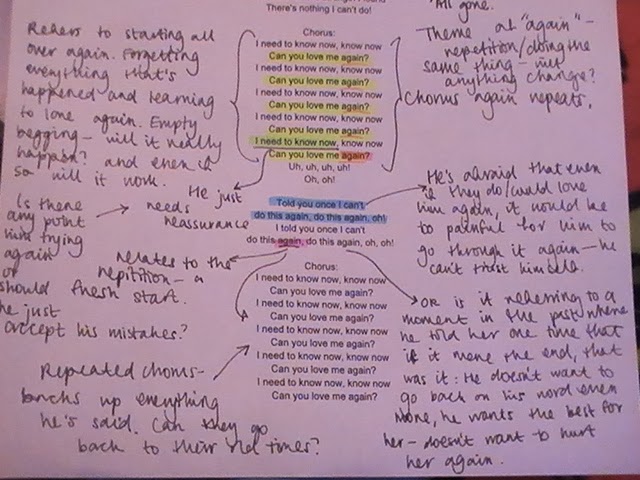
I thought I could adopt this approach within our music video, so I put my headphones in and had a go whilst listening to our chosen song, 'Love Me Again' by John Newman (UCF Remix). The result looks dynamic and filled with energy, which links to the song itself - being a dance/pop combination, it is designed to raise your heart rate and effectively motivate you to get up and dance. I think this is reflected in my own synaesthesia where there are lots of spiky lines and big shapes which represent the loud, pumping energy within the song.
Andrew Goodwin is a contemporary theorist and on the subject of synesthesia in relation to music videos, he believes the most succesful sort is:
"A clip that responds to the pleasures of music, and in which that music is made visual, either in new ways or in ways that accentuate existing visual assosiations"
~ Andrew Goodwin (1993)
I like his ideas; he is basically saying that when the visuals of media content complement the features of the sound, it all seems to come together and exaggerate what the visuals already in place. Also, when you are able to take in and understand the information your senses relay to you, you tend to have more interest in the content you are viewing, which in turn make the content more popular.
Steve Archer also provided many of his own ideas and opinions on the matter in the February 2004 edition of MediaMagazine. He believed that in order to judge appropriately, you need to fully be aware of the music and how it makes you feel.
HOW WE USED SYNAESTHSIA TO OUR ADVANTAGE
We did a task whereby we were asked to draw patterns, lines or markings - whatever came to mind - on paper, whilst listening to a certain music track. We basically had to draw what the music made us feel or what we felt represented that track to us the best. This would give us a better understanding of how the feel of the song affects the visuals that come naturally to us when listening to a particular type of music, which reinforces the importance of identifying and applying conventions of a certain genre.
These are the two tracks we listened to:
Tina Moore - Never Gonna Let You Go
Being an upbeat and dance sound, our page was filled with jagged lines and short, snappy swerves which represented the repetitive, catchy beat. It was a very loud and dynamic page, filled with energetic, bouncy markings which demonstrated that the track made us feel so.
Phoria - Red
This track in comparison had a much slower pace and less energy. The marks we made were much more flowing, continuous and spherical. It is still a powerful song, but uses it's impulsion is different ways to the above song. The marks we made became more dynamic towards the end when the son increased its pace and energy, giving a sense of empowerment.
I thought I could adopt this approach within our music video, so I put my headphones in and had a go whilst listening to our chosen song, 'Love Me Again' by John Newman (UCF Remix). The result looks dynamic and filled with energy, which links to the song itself - being a dance/pop combination, it is designed to raise your heart rate and effectively motivate you to get up and dance. I think this is reflected in my own synaesthesia where there are lots of spiky lines and big shapes which represent the loud, pumping energy within the song.
Monday, 23 September 2013
Todorov's Theory
Narratives must have events or happenings that are structured by causality (the relationship between cause and effect)
Todorov suggested a slightly more complex description of narrative structure than the simple situation - problem - resolution scenario. Instead he suggested these five stages:
~ The Quest: Where the hero is sent to sent to challenge evil and save the kingdom etc
~ Redemption Story: Where the central character sins, but redeems himself by self sacrafice
~ Journey to another world: When a character goes somewhere different and in turn changes
~ The Beast transformed by love: as title really e.g. Beauty & The Beast
~ The solving of riddles: Where there is a mystery to be solved e.g. Sherlock Holmes
~ The 'biter bit': Where the oppressed rise up and throw off the tryants
~ The Stranger Saviour: The stranger comes to town and acts as a catalyst for the residents to overcome their fear
~ The rise and fall: a family's or empire's rise to power and subsequent decline in their or it's fortune
We could use this in our music video when considering the narrative that will accompany the visuals.
Todorov suggested a slightly more complex description of narrative structure than the simple situation - problem - resolution scenario. Instead he suggested these five stages:
- Equilibrim: A state of balance at the outset, although doesn't have to be perfect - it just has to work
- Disruption: Disruption of the equilibrim, usually by the action of a villian
- Recognition: The characters and/or audience recognise the disruption
- Repair: An attempt to fix things (i.e defeat the villian)
- Reinstatement: Equilibrim is regained, although it is usually a new equilibrim to the original one.
~ The Quest: Where the hero is sent to sent to challenge evil and save the kingdom etc
~ Redemption Story: Where the central character sins, but redeems himself by self sacrafice
~ Journey to another world: When a character goes somewhere different and in turn changes
~ The Beast transformed by love: as title really e.g. Beauty & The Beast
~ The solving of riddles: Where there is a mystery to be solved e.g. Sherlock Holmes
~ The 'biter bit': Where the oppressed rise up and throw off the tryants
~ The Stranger Saviour: The stranger comes to town and acts as a catalyst for the residents to overcome their fear
~ The rise and fall: a family's or empire's rise to power and subsequent decline in their or it's fortune
We could use this in our music video when considering the narrative that will accompany the visuals.
Narrative, Plot and Storyline
Within one of our exam questions (1b) we are required to select one of our own productions and evaluate it in relation to media concepts. These concepts include:
So What is Narrative?
~ What distinguishes narrative from other forms is that it presents information as a connected sequence of events.
~ Progression - it links it all together.
~ The most basic narratives are linear - arranged in a straight line-like sequence (ABCDE). It is structured logically and is easy to follow as everything seems to make sense.
~ Many narratives sturcture their sequences causually; each event logically follows on from the previous one; each event causes the next event.
~ The majority are recountedin past tense.
~ Narative Hook: it should serve to intrigue the audience and give them a reason to keep on watching. This is often achieved through the use of an Enigma or McGuffin.
~ Most contain 'seeds' of the theme, which develop and grow later on.
~ Films which do not follow the conventions of a familiar genre can be harder to get into, as they have the potential to alienate the audience
~ Whilst sometimes it is the Director's intention to alienate the audience, most film openings incorporate generic conventions.
What is the difference between a story and a plot?
~ Films usually consist of events which are explicitly shown onscreen and events which are inferred to have happened off screen.
~ The Plot: everything that the film explicitly shows
~ The Story: the chronological order if all events explicitly shown and inferred.
Boris Tomashevsky
~ He suggested that the plot can be seen as the aesthetic arrangeent of ideas that teh firector wishes to bring to the attention of the reader.
~ So effectively the best bits of the characters' lives.
~ I think it is easy to follow this theory, as often with any film you watch, it is the conventional markers you see which move the plot along; you don't see the fill in bits of everyday life - which is just aswell really as you'd need the film in constant realtime, and would end up with a year long film!
Lion King
~ Is a good example, as we don't see many of the back stories - such as how Pumbaa and Timone met, how Scar and Mufasa were like as cubs, how Zazu became Mufasa's assistant etc.
~ We natually fill in the missing parts and details
~ However they did make some sequels following the success of the first film, so some of the holes are filled, but of course not all.
So it is now a whole lot clearer to me what measures to take when elaborating on the concept of Narrative within my exam question - there's a lot more to it than I thought!
- Genre
- Narrative
- Representation
- Audience
- Media Language
So What is Narrative?
~ What distinguishes narrative from other forms is that it presents information as a connected sequence of events.
~ Progression - it links it all together.
~ The most basic narratives are linear - arranged in a straight line-like sequence (ABCDE). It is structured logically and is easy to follow as everything seems to make sense.
~ Many narratives sturcture their sequences causually; each event logically follows on from the previous one; each event causes the next event.
~ The majority are recountedin past tense.
~ Narative Hook: it should serve to intrigue the audience and give them a reason to keep on watching. This is often achieved through the use of an Enigma or McGuffin.
~ Most contain 'seeds' of the theme, which develop and grow later on.
~ Films which do not follow the conventions of a familiar genre can be harder to get into, as they have the potential to alienate the audience
~ Whilst sometimes it is the Director's intention to alienate the audience, most film openings incorporate generic conventions.
What is the difference between a story and a plot?
~ Films usually consist of events which are explicitly shown onscreen and events which are inferred to have happened off screen.
~ The Plot: everything that the film explicitly shows
~ The Story: the chronological order if all events explicitly shown and inferred.
Boris Tomashevsky
~ He suggested that the plot can be seen as the aesthetic arrangeent of ideas that teh firector wishes to bring to the attention of the reader.
~ So effectively the best bits of the characters' lives.
~ I think it is easy to follow this theory, as often with any film you watch, it is the conventional markers you see which move the plot along; you don't see the fill in bits of everyday life - which is just aswell really as you'd need the film in constant realtime, and would end up with a year long film!
Lion King
~ Is a good example, as we don't see many of the back stories - such as how Pumbaa and Timone met, how Scar and Mufasa were like as cubs, how Zazu became Mufasa's assistant etc.
~ We natually fill in the missing parts and details
~ However they did make some sequels following the success of the first film, so some of the holes are filled, but of course not all.
So it is now a whole lot clearer to me what measures to take when elaborating on the concept of Narrative within my exam question - there's a lot more to it than I thought!
Thursday, 19 September 2013
Director Case Study: Director X
Director X is a Canadian director who has been working in the music video industry for over 15 years. His career as a director began with him directing the music video 'Richter Scale' by EPMD. He has worked with some huge names in the music industry including:
- Drake
- R. Kelly
- The Wanted
- Justin Bieber
- Nicki Minaj
- Sean Kingston
- David Guetta
- Ludacris
- Rihanna
- Usher
- Jay-Z
- Alicia Keys
- Little Mix
Here are some examples of his work:
Subscribe to:
Posts (Atom)